Accessible Tetris: a case study
What it means for Tetris to be accessible: an exploration of design method and interaction modalities from my doctoral research, with working examples of techniques, revisited for the modern web.
Why Tetris?
My PhD thesis used two case studies. The first looked at user and context profiling; the second looked at the rendering of content to match a given profile. Tetris was the second case study, and these pages are a self-contained account of it: what the game demands of a player, why conventional assistive technology cannot meet those demands, the interaction metaphors and software architecture I built in response, and what I learned along the way. The account closes with the design for a web-based demonstrator of these techniques, using spatial audio that browsers can now deliver natively.
Let me state the claim of this work carefully, because it is easy to misread and I have no wish to oversell it. The claim is not that I created an accessible Tetris game. The claim is that I considered what it means for Tetris to be accessible, as an exploration of design method and interaction modalities, with working, exploratory examples of some of the techniques. The 2009 work was about method and modality, not delivery. The adaptation it explored was grounded in my capability-modelling work and in the CISNA model of expressed adaptation that forms the core of the thesis. The web build these pages now serve is of the same character: a simple version of the game, constructed to demonstrate those techniques in action and to reference directly back to the CISNA work. It is not a finished product claiming to have solved the problem.
I chose Tetris deliberately, to be difficult: because it is hard, not because it was doable. The classic static view of content embodied in the web’s document models, and in operating-system “accessibility layers”, is a solved problem by comparison. A dynamic, animated game with retained state, random elements, and hard timing is a challenge of a different order. What really defeats existing assistive technology is the proximal content inherent in the game: rotating and guiding falling shapes to match gaps in the landscape below. A screen reader can tell you a button’s name. It has no vocabulary at all for “the T-piece is two columns left of a T-shaped hole and falling fast”. If an approach to accessibility claims to be better than existing assistive technology, this is the kind of context where it must prove itself.
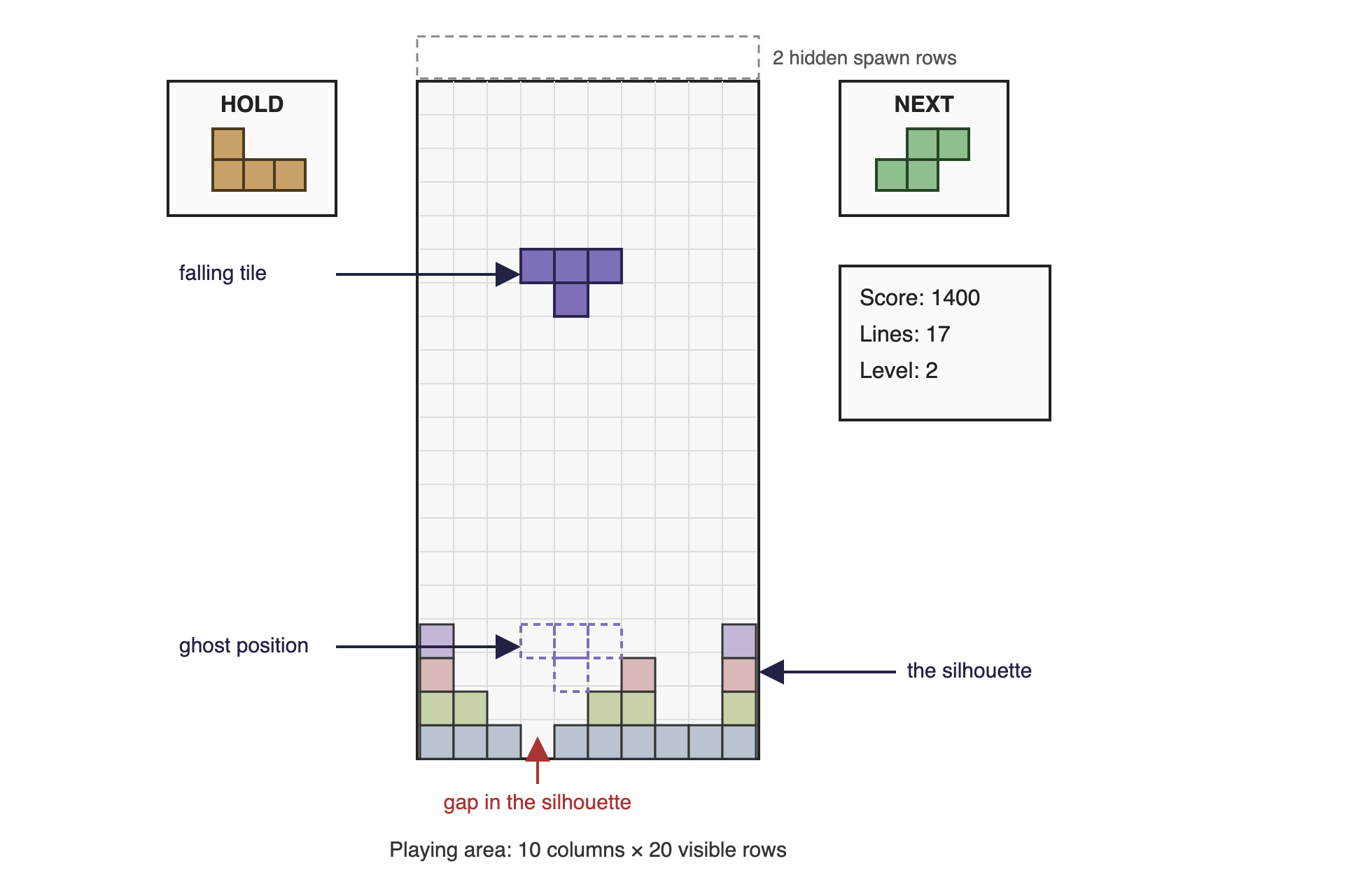
Tetris also demanded adaptation both within and between design spaces (visual, sonic, and haptic). Since the target hardware was an unmodified laptop, haptic adaptation was constrained to user input and its feedback rather than general content presentation, which concentrated the research question nicely: can the full state of a real-time spatial game be delivered through sound?
Two outcomes interested me: the impact on user-interface design of designing for adaptability, and the practical ease (or otherwise) of adapting content to match user capability and context. A degree of failure was expected, particularly where time-critical, contemporaneous information streams meet the comparatively low bandwidth of the sonic design space. That expectation shaped the architecture, as the later pages show.
This revision of the case study also does something the original could not: it holds the work up against the wider record, taking in the cognitive science of Tetris, the accessible-games literature, and what players and studios have built since. The record reports plainly where that record supports these concepts, where it challenges them, and what I simply had not considered.
The parts
- The game and the player: the rules as specified, and the cognitive load they place on a player.
- Why assistive technology fails: transliteration, metaphor, and a vocabulary for game presentation.
- The sonic design space: seven invented audio metaphors with field notes, and the first-person shift they revealed.
- An architecture for adaptation: domains, the asynchronous bridge, and state models whose game clock waits for the user.
- What the browser makes possible: the spatial-audio design for the web, from timbres to the listening views.
- The record: where the research literature supports these concepts, challenges them, and exposes blind spots.
- From case study to demonstrator: the plan for the web build, and its commitments.
Materials
The full case study, its figures, the research notes, and the engineering design live in the project repository: accessible-tetris on GitHub (opens in a new window). The theoretical frame is the CISNA Model; the research-vehicle argument is at Tetris as accessibility testbed. Tetris® is a trademark of The Tetris Company; this is non-commercial accessibility research, and no Tetris Company assets are used.