The game and the player
The rules as specified, and the cognitive load they place on the player: five contemporaneous information channels, five distinct timeouts, and a game that is almost completely visual by specification.
The game
There are many variations on the classic 1985 game. Modern licensed versions conform to the Tetris Guidelines controlled by The Tetris Company; the guidelines themselves are available only to licensees, but community documentation derived from studying licensed games describes them well.
The essentials: the game is about managing falling bricks so that they form complete horizontal lines within the playing area. Each completed line disappears and scores points; completing multiple lines simultaneously multiplies the score. The falling bricks are one of seven defined shapes, the tetrominoes, each constructed within a 4 × 4 frame and occupying four squares of it.
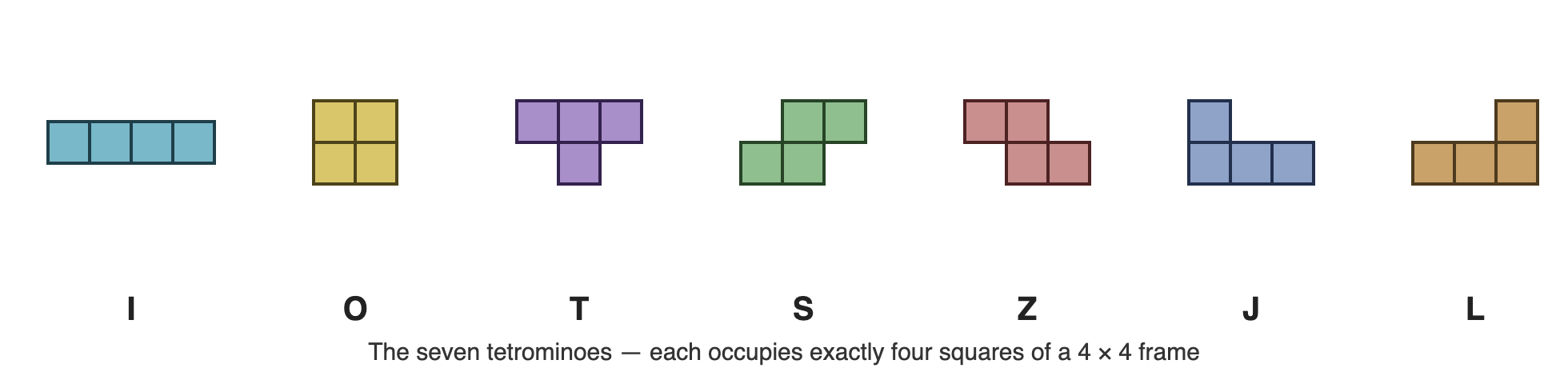
The playing area is a visible grid of 10 columns by 20 rows, with two hidden rows at the top in which pieces begin their fall. As a piece falls the player may move it left and right and rotate it, subject to rotation rules that vary between versions; modern licensed games use the Super Rotation System (SRS). A piece falls until it reaches the bottom row or is impeded by an already-fallen piece. For a short period after landing it remains movable, so it is possible to slide a piece sideways under an overhang, and potentially for it to begin falling again. Once the piece times out into its locked position, the next piece begins to fall. The game ends when the stack reaches the top of the visible area so that a new piece cannot begin its descent.
The next shape is always known to the player. The Guidelines add a hold box: the current falling piece may be swapped out, once, for either the previously held piece or (if the box is empty) the next piece. Modern versions also require a ghost piece, a translucent projection showing where the current piece would land if hard-dropped; it supports the hard drop control for players happy with that position. Ten levels of play raise the fall speed every ten completed lines. Control on a PC is by keyboard, with specific keys mandated by the Guidelines, and press-and-hold auto-repeat on lateral movement. Finally there are the corner cases, literally: rules for rotating a piece perched against the corner of another, the celebrated T-spins, which score bonus points.
The game as specified is almost completely visual, demanding visual pattern-matching in a time-limited environment. The sound specification is limited to requiring particular Russian folk music. Haptically, the game is optimized to key presses. That asymmetry, with everything in one design space and almost nothing in the others, is what made it the right case study.
One thing has changed since I first wrote this description: the stacker community has codified the modern game far more thoroughly than the leaked-guideline documents of the 2000s. SRS kick tables, the 7-bag randomizer, DAS/ARR movement-tuning conventions, and T-spin scoring are now community-documented standards, with open implementations (NullpoMino most completely) serving as de-facto behavioural references. Behavioural correctness is now checkable, not a vibe, which makes fidelity an explicit choice rather than an accident. A demonstrator of adaptation techniques can legitimately choose a simpler rule subset, provided the choice is stated rather than smuggled.
What Tetris asks of the player
Tetris is a deceptively simple game that places significant cognitive load on the player, especially as speed picks up. The player is expected to:
- Recognize seven basic tiles.
- Follow the movement of one tile down the playing area whilst assessing its landing position.
- Match the outline of a moving tile to gaps in the silhouette at the bottom of the playing area.
- Optimize that match to fill horizontal lines in order to score points.
- Optimize that match to take account of the known next tile.
- Optimize that match to take account of how some tiles can rotate around the corners of obstacles.
- Optimize that match to fill more than one line simultaneously, for the score multiplier.
- Optimize that match by holding, and later re-using, currently unsuitable tiles.
- Match not only vertical gaps in the silhouette but horizontal gaps related to its raggedness.
- Continue to succeed at (a) through (i) whilst the game speed increases.
Contemporaneous elements
In terms of game state, there are nine elements alive at once:
- The current tile, its relationship to the playing area, and the time it has dwelled at its position (for game speed and for the lock timeout).
- Previous tiles still visible in the playing area, forming the current silhouette.
- The relationship of the current tile to its ghost position relative to the silhouette.
- The shape of the next tile.
- The shape of the held tile, if any.
- The current level.
- The number of lines completed.
- The current score.
- Historic high scores.
Their importance varies through the game. While a tile is falling, the player needs (a) through (e); (f) through (i) matter once a tile has locked and line-completeness has been determined. That still leaves five contemporaneous information channels during the fall, some far from trivial; the tile-to-landscape relationship is a continuously changing spatial judgement. A sighted player absorbs all five in a single glance. This, condensed to one sentence, is the whole accessibility problem: vision is a parallel medium and sound is a serial one, and any sonic rendering must ration what it says.
Timing considerations
Five distinct timeouts operate inside the game:
- Dwell time for a falling tile as it passes through each row.
- The lock timeout when a falling tile meets an obstruction.
- The delay before the next tile appears after the current one locks.
- The auto-repeat rate for move-left and move-right.
- The key dwell time needed to recognize a press at all.
Each is impacted by user capability and by device capability. This list turned out to carry a lot of architectural weight: every one of these timings eventually became a negotiation between the game and the user interface rather than a constant. The scale of the eventual accommodation is worth noting. In the working PhD implementation, the per-row fall delay ran at 300 ms in the visual configuration and 4,000 ms in the sonic one: the same game, thirteen times slower, and still recognizably Tetris.