An architecture for adaptation
One abstract game, independently rendered views, and a game clock that waits for the interface: domains, the asynchronous bridge, and state models that carry adaptation into control flow.
Domains
The case study models Tetris as a Shlaer-Mellor domain chart. The abstract game is the application domain. Two service domains render it, the Visual View and the Sonic View, each rendering all, some, or none of the abstract game according to the capability of the current user. Input is delegated to its own service domain, and models of capability to a User Capability domain, which describes a user’s physical and cognitive capabilities: how effectively they can press a location, how easily they can hold a press. One implementation domain appears: the keyboard event model of the implementation language. And one bridge deserves notice: Input connects to the Sonic View, because mechanical input has audible feedback that the sonic rendering must own.
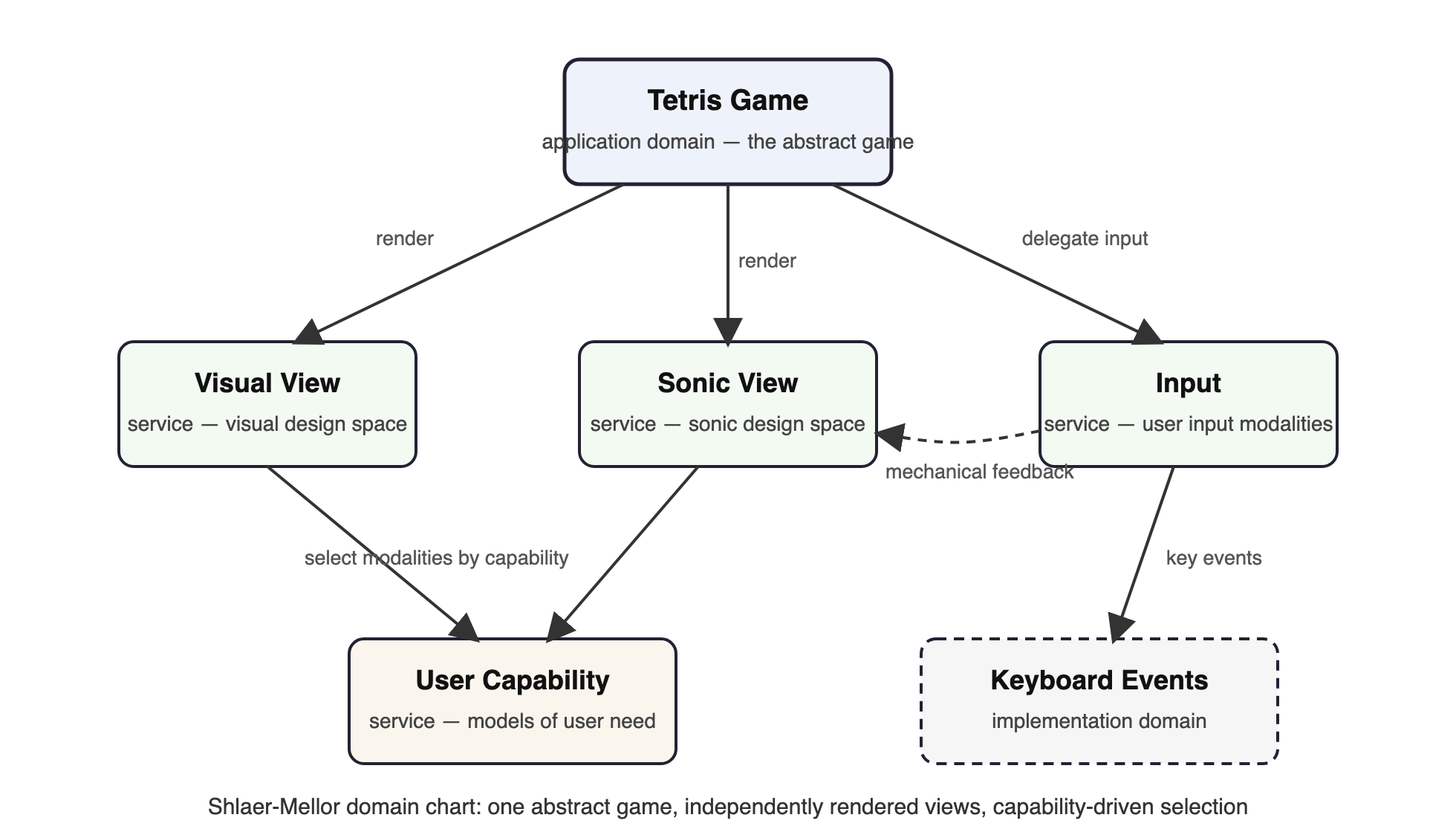
The visual components correspond to the existing Tetris Guidelines; the sonic components are the invented metaphors of the previous part. The renderings are peers. Neither is the “real” game with the other bolted on, and that symmetry is the point of the architecture.
I should be plain about provenance here: I was not alone in reaching this architecture, and I did not know it at the time. In the same era, Grammenos, Savidis and Stephanidis at FORTH were building what they called universally accessible games (Access Invaders, Game Over!) under a “unified design” methodology: one abstract game, adapting its rendering to player abilities rather than shipping segregated special versions, with their evocative term parallel game universes for concurrently playable, differently-rendered versions of the same game. That is this domain chart wearing different clothes. The convergence supports the idea, since two groups independently concluded that accessibility of dynamic content demands an abstract core with adaptive rendering, but it deflates any claim that the architecture itself was unique to my work. What I still believe was distinctive here is further down the stack: the game clock that waits for the interface, the transaction-scoped request/answer discipline borrowed from telephony, and the treatment of the sonic design space at the level of metaphor rather than feature.
Two approaches to adaptation
Two approaches were envisioned. The manual approach built the game with templates defined for a small number of representative user profiles, each selecting appropriate interaction modalities. The automated approach considered the constraints and rules necessary for the game to self-adapt to user capability and operating context. Both rely on the same abstract description of the game’s dynamic operation, independent of how it is rendered or how input is collected. The automated approach was expected to fail more often, since it must itself make the modality-selection judgements a designer makes in the manual approach, and the quality of the metadata attached to the abstract model constrains how well modalities can be grouped into a consistent, comprehensible interface.
The asynchronous bridge
The interface between game and UI is entirely asynchronous, and must be, because an abstract game has no way of knowing how long a communication with the user will take in any given design space. Even “the game is starting” took significantly different times in the two views (a colour ripple across the grid; a spoken announcement), and the game must synchronize with both before dropping the first tile.
This forced a decision with philosophical weight: can the rendering of the user interface delay the fall of the tile? My answer was yes. The principle is that the UI adjusts to the capabilities of the user, and if the user cannot receive information within a given timeout, then the game itself must adjust. Accessibility reaches all the way down into the game clock. (A multi-user or augmented-reality game might need the opposite decision, letting the game catch up with the world; single-player Tetris has no world to appease.)
The repeated asynchronous behaviour reduces to a simple pattern: a request/answer pair with a rendezvous on the answer. Diagrammatically it resembles UML sequence charts, but the concept goes back to the CCITT/ITU message sequence charts used to describe telecommunications protocols.
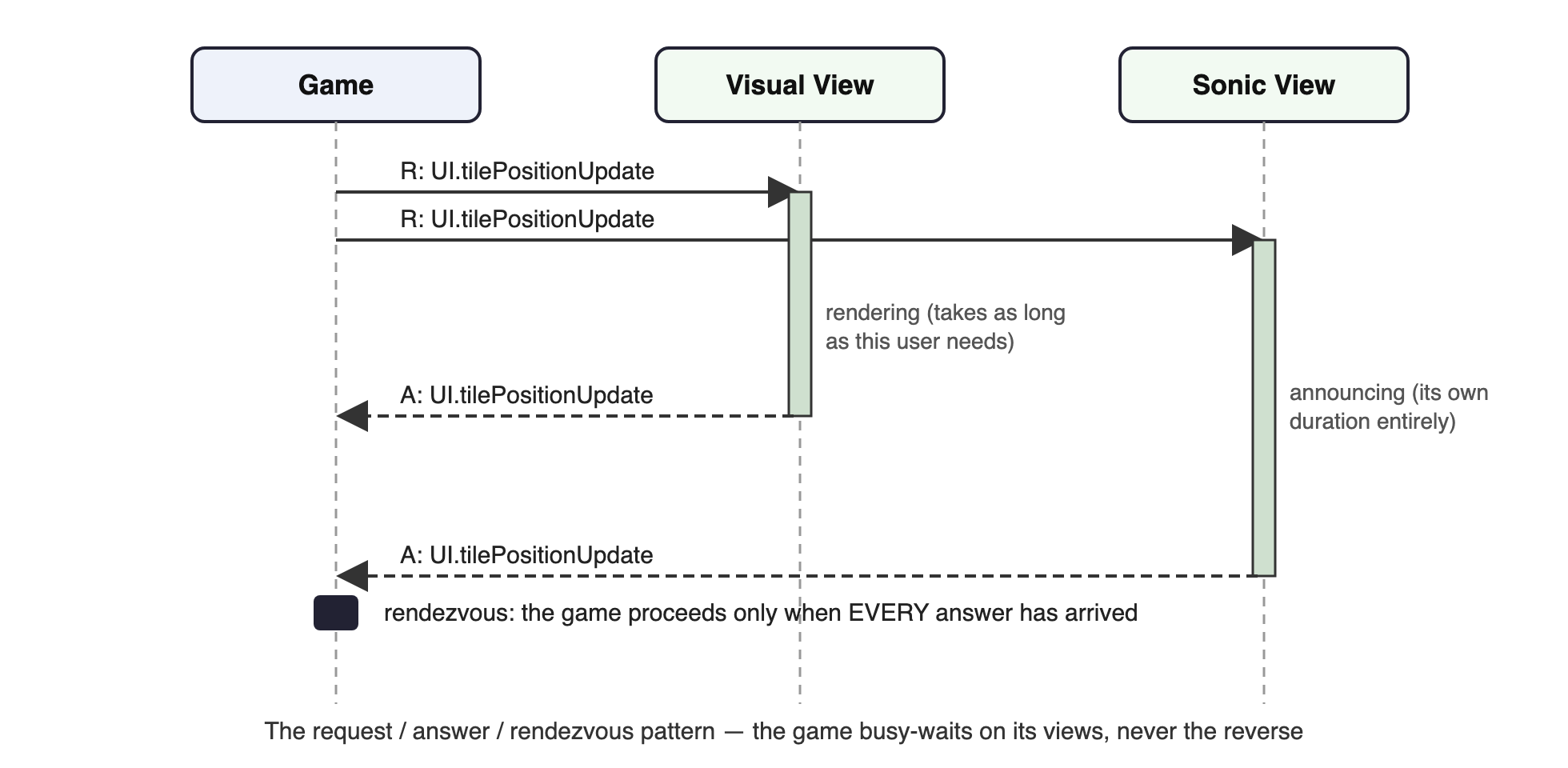
I did not invent that pattern for Tetris. In the mid-1990s I was Software Group Leader on the Ascom PABX, a small digital telephone exchange developed almost entirely with the Shlaer-Mellor method. An exchange is asynchronous communication incarnate, and the project relied heavily on sequence-chart patterns to describe the bridges between domains. Three hard lessons from that work transferred directly to Tetris:
- No notification/response pairs. Every deadlock the analysts created traced back to a server treating its client as a server, so the pattern was banned outright.
- The client is fixed. For any pair of domains, one is client and one is server, and the roles never reverse. A server may send an unsolicited indication, which may prompt the client to open a transaction, but the server never opens one.
- Only the client starts a transaction. Where several request/answer pairs complete one client intention, they are wrapped in a database-style transaction so that exception cases can be handled coherently.
Synchronous events between domains had also caused deadlock at Ascom (clients blocked while a server’s own onward requests completed), so between domains everything became asynchronous, with clients explicitly busy-waiting on answers where sequencing demanded it.
Notation: making Moore state models say more
Shlaer-Mellor expresses object behaviour with Moore state models, and the asynchronous patterns above needed to be visible in those models. I extended the notation with event prefixes:
- I: an indication; no direct response required (“key pressed”).
- R: / A: one half of a request/answer pair. The pair share an event name, prefixed by the (conceptual) target: conceptual, because the game requires the service of a user interface without knowing which domains provide it.
- TS: / TE: transaction start and end; constituent events carry the transaction ID.
- D: an internal decision event, generated and consumed within one state model, acted on immediately, ahead of any queued event. This is the mechanism behind the transient decision states that illuminate the algorithm’s branch points.
- X: cancel an outstanding request/answer pair, an extension implying the prefixes are not mere annotation but are honoured by the runtime architecture beneath the model.
The state models
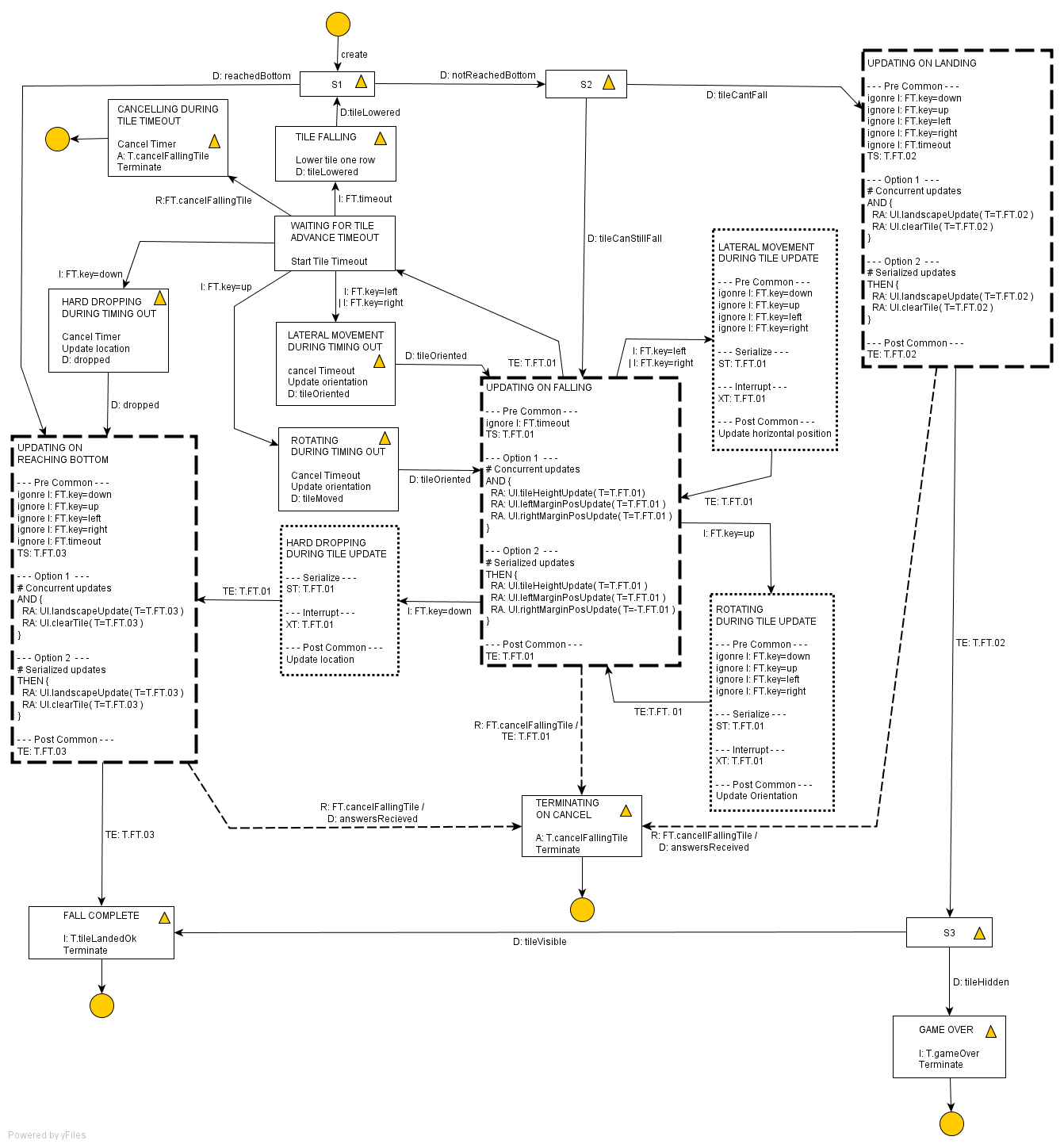
The abstract game needs only two concurrent state models: Game, handling the start/stop sequence and the hold box, and FallingTile, handling the current tile’s descent and determining whether a new tile is needed or the game is over.
The original prototype FallingTile was a simple object listening for a timer tick; the survivor of that version appears in the appendix of the thesis chapter as a page of straightforward Java. The moment FallingTile had to communicate asynchronously with the UI, the simple model broke: the algorithm must pause while the UI does its job. Everything that follows is the price, and the payoff, of that pause.
An early draft of the Game model made the cost visible. The main body (tiles are created and keep falling until the game is over, plus the hold extension) is simple; all the rest of the model exists to handle termination, complicated by the asynchronous bridge. Three stylizations tamed the complexity.
Hidden await-states. A dotted transition labelled R: FT.cancelFallingTile / A: FT.landscapeUpdate means: on the cancel request, await that specific answer, and only that answer, before completing the transition. Each dotted line is a hidden state that would otherwise bloat the diagram.
Interruptibility meta-states. When hard drop was added, the question arose: if the game is mid-announcement of tile position, should hard drop interrupt the announcement or queue behind it? Without knowing the character of the current interaction modalities, the answer is unknowable. Visually, interrupting a grid refresh is free; sonically, interrupting the dancing margins mid-phrase may confuse. So the model itself must carry both strategies. A meta-state (“HARD DROPPING DURING UPDATE”) holds the alternatives, serialize after the outstanding transaction or interrupt it with X:, with the choice deferred to rendering time. Modality-dependence reaches into control flow: having selected modalities for a user, the game must adapt its synchronization policies to match their characteristics, and without such feedback the conservative rule is that serialization beats interruption.
Contemporaneous-announcement meta-states. When a tile lands, the landscape updates and the tile disappears; when a tile falls a row, its height and both margins may all need announcing. Are these simultaneous or sequential? At the abstract level the truthful answer is “whichever the user’s modalities can deliver”, so the meta-state (for example “UPDATING ON LANDING”) lists alternatives in preference order: Option 1, concurrent updates (AND { RA: UI.landscapeUpdate, RA: UI.clearTile }); Option 2, serialized (THEN { … }). The preferred option is concurrency; the fallback is sequence. Expanded to plain notation, each meta-state is a combinatorial fragment that grows with the number of announcements. The stylization is what keeps the model on a page.
One question from this modelling work stayed with me. The single event “tile added to landscape” is a higher abstraction than the pair “update landscape, clear tile”. At what level of abstraction may an abstract model speak? Position and movement are common concepts; is “landed”? The answer lies in the metadata and ontologies applied to abstract model events (without them, no rendering algorithm could choose its metaphors), and that question formed the starting point for the bridge between the Game and Capability domains.